Scenarios are stress tests, not forecasts
A scenario is not a guess about what will happen. It is a coherent world built to test whether a plan survives conditions you have not assumed. Judged as prediction, scenarios always look wrong. Judged as stress tests, they earn their place.
Choose the uncertainties that actually matter
Most scenario work fails at the selection step. Teams build variations around the uncertainties that are easiest to describe rather than the ones that would most change their decision.
A short discipline helps: list the uncertainties, mark each for impact on the decision and for how little you know, and build scenarios only around the ones that score high on both.
Build paths a team can argue with
A useful scenario is specific enough to be disagreed with. It names what changes, who reacts, and what that would look like early. Vague optimism and vague pessimism are not scenarios; they are moods.
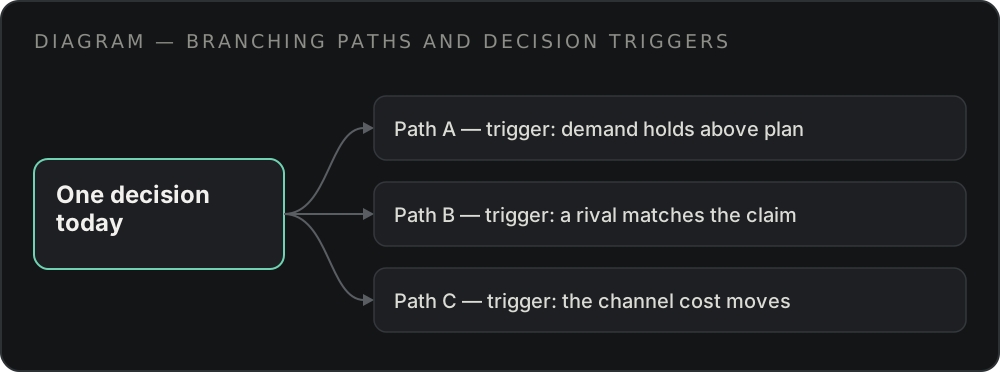
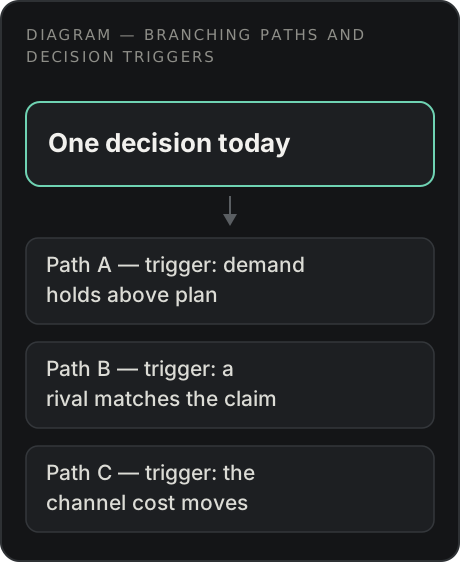
Turn scenarios into triggers
Scenario work pays off when each path is attached to an observable signal and a pre-agreed response: if we see this, we do that. Without triggers, the exercise ends as a document. With triggers, it becomes a way of noticing early.
A scenario earns its keep the moment someone can disagree with it precisely.
- Which uncertainty would most change our decision?
- What would the first three months of each path look like?
- What signal tells us which world we are in?
- What have we agreed to do when we see it?
ATLASIO.ai lets you set up this kind of question as a scenario and explore how simulated customers and market actors could respond, using the evidence you already hold. Results are decision-support signals — possible outcomes, not guarantees.
Editorial perspective. No customer names, studies, statistics or results are cited on this page.