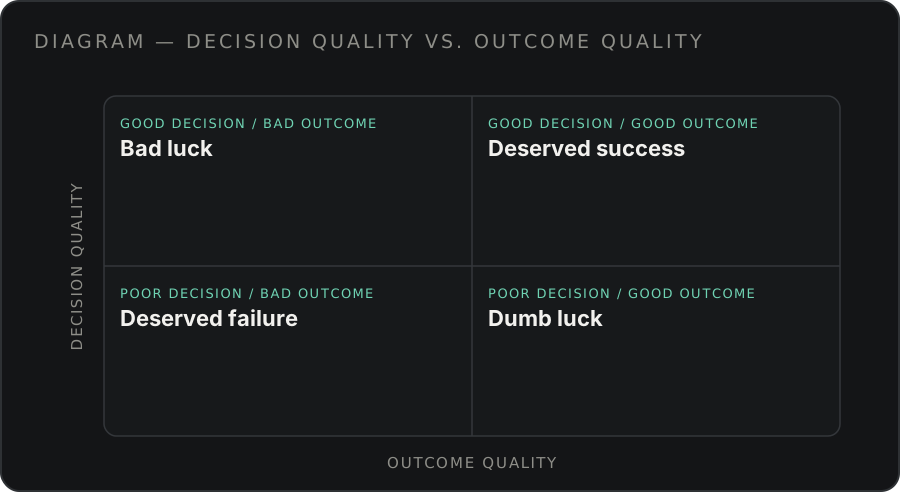
Decision quality and outcome quality are different things
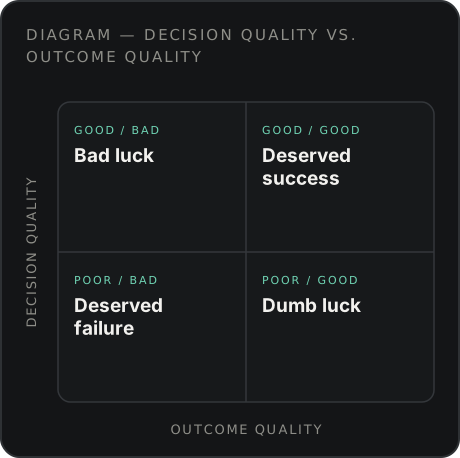
A decision can be well made and still turn out badly. A decision can be careless and still turn out well. Teams that judge only outcomes end up learning the wrong lessons twice: punishing sound reasoning that met bad luck, and rewarding luck that looked like insight.
Separating the two is the first discipline of a serious decision process. Judge the reasoning on what was knowable at the time; judge the outcome on what actually happened; keep the two reviews apart.
Where research quietly stops being predictive
Research describes conditions that held while it was collected. When a decision changes those conditions — a new price, a new claim, a new competitor response — parts of the evidence base silently expire. Nothing in the deck announces this.
The practical fix is to label evidence by how sensitive it is to your own move. Evidence that survives your decision is durable. Evidence that your decision invalidates needs to be re-examined as part of the decision, not treated as a foundation.
Second-order effects the plan never priced in
Most surprises are not about whether customers liked the move. They are about what the move triggered elsewhere: a competitor response, a channel conflict, a shift in who the offer attracts, an internal capacity limit that only appears at volume.
Exploring possible responses across several actors — not just the target customer — is where a lot of avoidable failure gets caught early.
What a decision review should ask
Good reviews reconstruct the decision, not the outcome. What did we believe? What would have changed our mind? Did we look for that evidence? Which assumption actually failed? Would we make the same call again with the same information?
Judging decisions by outcomes alone teaches a team to be lucky, not to be good.
- Which assumptions did this decision depend on, in writing?
- Which of them did our own move invalidate?
- Who else responds, and how would we notice early?
- What would we have needed to see to choose differently?
ATLASIO.ai lets you set up this kind of question as a scenario and explore how simulated customers and market actors could respond, using the evidence you already hold. Results are decision-support signals — possible outcomes, not guarantees.
Editorial perspective. No customer names, studies, statistics or results are cited on this page.